Garudasana – Master of the Sky

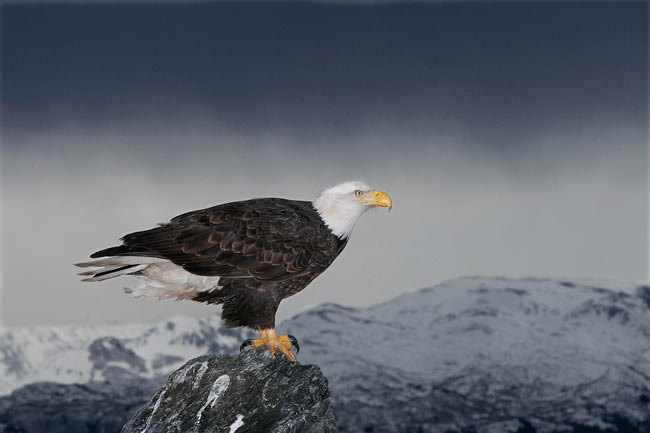
Bald Headed Eagle

Garudasana – Master of the Sky.

You are the master of the sky, with eyesight sharp enough to see your prey from a mile away. With calm, steady focus and as light as the feathers that carry you, you sit aloft searching the land below. High above the ground the air is silent; if you held your breath you would hear a pin drop. You spot your prey. Time freezes and, in that split second, you focus and you dive.

Maybe a little dramatic but I have a love for the focus of the mind that Garudasana (Eagle Pose) brings. I like to use this imagery in my class and also in my practice; I want my students to reach a point of meditation and concentration where everything goes silent, just like the moment before the eagle dives when time appears to stand still.

The way our arms and legs are entwined in Garudasana is very grounding, as every limb is hugging in towards the midline of our body. This gives a sense of stability and strength. The concentration needed to balance and hold the pose provides a sense of focus and the slow, meditative breathing needed to quiet the muscles of our face and steady the nerves, allows for calmness.

Physiologically,Garudasana strengthens the ankles, calves and thighs, helps to build core strength and stretches the hips, shoulders and upper back.

So next time you are in your Eagle Pose, have a go at visualising the King of Birds, perched high and observing his prey. And, when you are ready to dive down, open your wings and fly into Warrior 3.

For details on how to do Garudasana go to http://www.yogajournal.com/poses/785


Ujjayi Breath

Ujjayi Breath is a form of Yoga breathing (pranayama.) It is known as Victorious Breath, also Breath of the Ocean.

Why Victorious Breath? With Ujjayi the abdomen is lightly contracted and the pelvic floor lightly lifted rendering less space for the more common belly breathing. With this gentle restriction in place the breath is drawn into the chest cavity and side ribs, having the chest puffed out in this way gives the look of someone haughty & proud, someone victorious.

Further to this, Ujjayi breath produces a mesmerizing sound. There is a gentle constriction at the back of the throat on both the breath in and the breath out through the nostrils. Have you ever held a large shell to your ear as a child and marveled at the distant sound of the ocean trapped in side? This is how your Ujjayi Breath should sound hence the name Breath of the Ocean. Ujjayi’s texture and sound allow a focal point for meditation.

Ujjayi is also used to lengthen the breath. When we lengthen breath in this way it has a direct calming effect on the nervous system. Our bodies are in a constant state of flight or fight due to the stress and demands of modern day life. If we can take a moment to simply sit and breath we can connect with our parasympathetic nervous system allowing it to reset and our hormones to balance once more.

I personally like to use Ujjayi when I practice Vinyasa Yoga. It provides a rhythm and a focal point during my practice. From a physiological point of view, Krishnamacharya (referred to as the Grandfather of modern day yoga) said that “Ujjayi Pranayama is a balancing and calming breath which increases oxygenation and builds internal body heat.” This is obviously important when considering Vinyasa’s more aerobic nature as the muscles need to be fully oxygenated for energy metabolism to take place.

Above all, Ujjayi breath gives me a grounding focus during my practice, helping me transition from one pose to the next keeping my core engaged, helping me lengthen and calm my breath when holding a more challenging asana and finally acting as a guide for my mind to recognise when I lose control of my breath – a clear signal that my body is worn out and it’s time to back off.

Have a look here for more information on Ujjayi Breath: http://www.yogajournal.com/poses/2485

Banging on about Back Bends – Urdhva Dhanurasana

Image

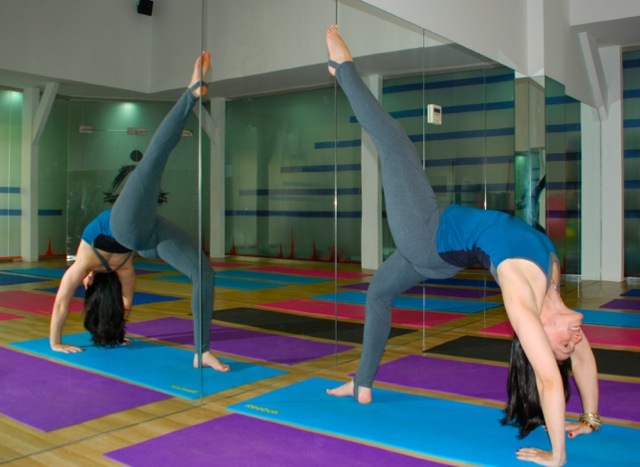
Upward Bow or Wheel Pose. One of my favourite asanas. I enjoy the practice leading up to full wheel as it allows for some creativity. I like to include gentle back bending in the initial flows; like slight back bends in Crescent Lunge during the Surya Namaskar B to warm the spine and core muscles slowly.

Urdhva Dhanurasana requires a huge amount of flexibility in the hip flexors (Iliopsoas), a group of muscles that are constantly in a state of flexion during our every day life; sitting, walking, driving the car, it all take its toll on our hip flexors. Before performing a strong back bend like Wheel Pose it is important to warm up the Iliopsoas and their assisting muscles, the thigh muscles (quadriceps). This is another reason I like Wheel so much, it gives me the opportunity to include deep hip flexor stretches like Anjayneasana as preparation poses.

To open our chest in this way also requires the flexibility of another group of muscles that is prone to flexion on a daily basis, our pectorals. Even now as I type away my pectorals (chest muscles) are in a state of contraction/flexion. My shoulders are rounding forward and my neck is taking the brunt of my poor posture. How good does it feel to stretch your arms open wide after you’ve been sat at your office desk or driving for a long time? It feels great doesn’t it. Our bodies benefit from engaging our under used back muscles and lengthening through our overused chest muscles and this is exactly what back bending is all about.

Regarding wellness, back bends are the best asanas to counter depression, low self-esteem, fear and lethargy as they lift and open the chest, lungs and diaphragm. A place where many hold tension. It also takes courage to open the chest in this way as in doing so we expose our heart. The human psyche dictates that we should protect the heart, not just physiologically but psychologically too. Therefore opening the chest in this way also opens the heart to the world symbolising the acceptance of oneself and the willingness to share that with others. A brave act indeed.

So in short the benefits are:

  • Stretches the chest, lungs, hip flexors and thighs.
  • Strengthens the arms and wrists, legs, buttocks, abdomen, and spine.
  • Counter depression and lethargy
  • Improve self-esteem
  • Improve confidence
  • Stretches the chest and hip flexors
  • Emotionally releasing
  • Demand strength and will power – empowering pose
  • Energize the body and mind

(If you have any other great benefits that you would like to add then please get in touch through my contact page)

Private Yoga Teacher – is private tuition for you?

What are the pros and cons of private yoga classes versus yoga group classes? I love the theatrics of a group class, an expressive teacher leading us as one through a beautifully choreographed sequence, the music, lighting. It can be very entertaining, very social, fun and balancing.

However, group situations aren’t for everyone and in this case private yoga tuition is a great way to tip toe yourself into yoga if you have never tried it before. Or perhaps you simply prefer to practice one to one.

Private yoga is also great for anyone wanting to increase their knowledge of yoga and improve their own practice. One to one tuition brings about a whole new awareness of the alignment of your body, it can also give you the confidence to try out new poses.

My personal preference is a mixture of the two. Group classes for sharing and private tuition for honing.

Five unexpected outcomes of teaching Yoga.

1. I have constantly filthy feet!

2. Students seem to sense when you are about to offer them an adjust and align their bodies without you having to utter a word.

3. Everyone’s downward dog looks completely different and they are all beautiful.

4. Students love new yoga insight, like trying out new mudras and pranayama.

5. Savasana has its own unique energy, like a calm ocean; On the surface it feels calm and serene yet there is a sense of great depth and power.

Yoga Guru Tirumalai Krishnamacharya

Following my Yoga teacher training I decided to research more into the Granddaddy of Yoga Tirumalai Krishnamacharya. A truly inspirational Yoga Guru who had never stepped foot out side of his own country yet his philosophies and teachings spread world wide. His life mission was to heal people through Yoga, he achieved this during his lifetime and continues to heal us all through his legacy.

“Teach what is inside of you, not as it applies to you, but as it applies to others” – Krishnamacharya

Artists and Inspirations

I had the amazing opportunity to meet two fabulous artists this week. One is the very delightful Lynessa Clemente founder of Lynspirations – her truly beautiful hand crafted jewellery. Lynessa hand makes the paper beads using magazines, brochures or left over wrapping paper, any paper she can get her hands on really! She will even tell you what magazine she used to make your bespoke piece. I bought several items, one was made from a real estate advert another from Homes magazine. I spotted a super bright creation, this was made from a comic strip! Every paper bead is time consumingly wrapped to create its shape then glazed for a lasting effect. I love Lynessa’s designs and individuality.

My other inspiration this week is the Graphic Artist Sasan Sam Nasernia. He has taken the leap from Graphic Art to Acrylics with an astonishing outcome. His canvases are bold and unique, a mix of graphics with modern calligraphy painting. Have a look at his work here https://www.facebook.com/pages/Calligraphy-Painting-By-Sasan-Nasernia/102093259971050?fref=ts

That said, I have an acrylic painting class booked this week… after meeting such great artists I feel very inspired indeed. I’ll be sure to post up my efforts even if they aren’t all that good 😛 wish me luck.

 
Design a site like this with WordPress.com
Get started